

How to scan a new place in 10 seconds, read the signs that come before a street attack, hold a boundary from a calm stance, make escape your only goal, and set up a check-in routine so someone would notice if you went quiet.
Get help: If you are in danger now, call your local emergency number (911 in Canada and the US, 999 or 112 in the UK, 000 in Australia, 112 across Europe). After an assault, get medical care quickly even if you don't plan to report it. For support: US, RAINN 1-800-656-4673; UK, Rape Crisis 0808 500 2222 (England and Wales) or Rape Crisis Scotland 08088 01 03 02; Australia, 1800RESPECT 1800 737 732; Canada, your local sexual assault centre. Crisis lines in every country are listed at findahelpline.com.
How This Plan Works
Most of what keeps you safe happens before anything goes wrong. Street robbers weigh how easy a person is to approach, how easy they are to overpower, and how easy it is to get away afterwards [4]. Each of the five skills here makes you a worse choice on one of those counts, without making you afraid.
Step 1 makes you hard to surprise. Step 2 gives you a reason to leave early. Step 3 keeps a stranger at a distance while you leave. Step 4 is the plan for the rare moment none of that is enough: get away, get loud, get help. Step 5 makes sure someone would notice fast if you went quiet.
Step 1: Scan a New Place in 10 Seconds: Exits, People, Light
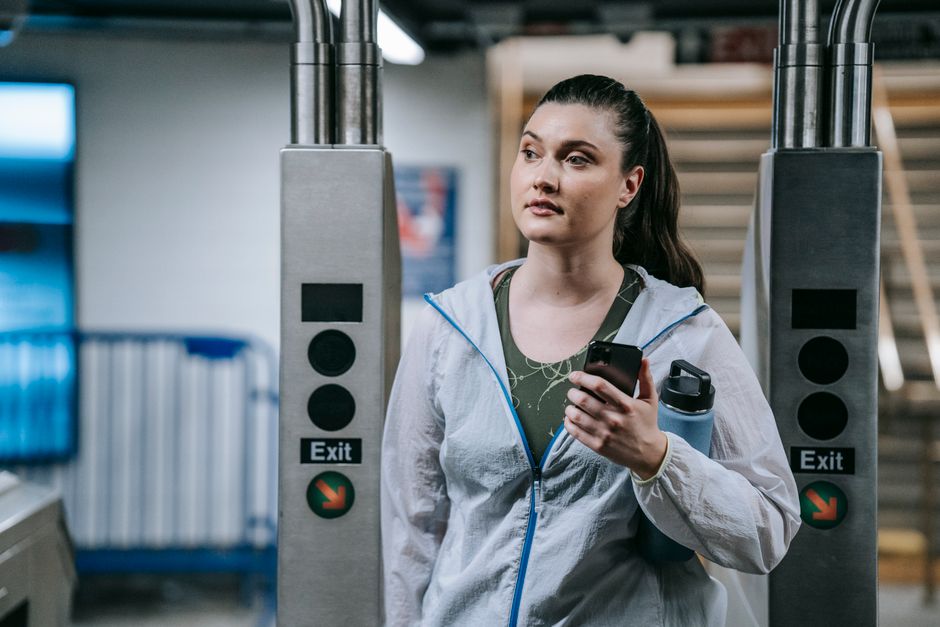
SKILL: You can scan a new place in 10 seconds (exits, people, lighting, what feels off), with your phone away and keys out at doors, car parks and lifts.
WHY THIS MATTERS
Your attention is limited. In a field study, people walking while talking on a cell phone walked more slowly, changed direction more often and were less likely to acknowledge other people than people walking alone, in pairs or with music [3]. In a second study on the same route, phone users were less likely to notice a unicycling clown riding past [3]. If a clown on a unicycle is easy to miss, a person slowly closing the gap is easier still.
Offenders notice this too. A U.S. Department of Justice guide for police says street robbers look for victims who seem unaware of their immediate surroundings, and names pedestrians who look lost, are using a phone, are rummaging in their bags or are listening to music [4]. It also says robbers may see people who are drunk or unfamiliar with an area as easier to approach and overpower [4]. The guide's own advice for public awareness campaigns is to keep valuables hidden and stay alert outdoors, avoiding phone calls and music [4].
- The 10-second scan. Each time you walk into a new place (a car park, a bar, a station, a lift lobby), take 10 seconds for four checks: two ways out, who is here and what they are doing, where the light is and where it isn't, and anything that feels off.
- Phone away at transitions. Put the phone in a pocket for the last stretch before a door, a car park, a lift or a stop, and for the first moments after. These are the places where you slow down, look down and fumble for things, which is what the police guide describes [4].
- Keys out before the door. Have your keys or card in hand before you reach your door or car, so your eyes stay up and you don't stand still searching your bag [4].
- Read the people, not their looks. In your scan, notice what people are doing: waiting for a bus, chatting, working, or standing with no clear reason near the exit or your car. Behaviour tells you more than appearance.
- Pick your spot. In a bar, a waiting room or a station, sit or stand where you can see the entrance and reach a way out, near light and other people.
- Head up, steady pace. Walk as if you know where you are going. If you are lost, step into a shop or a lit doorway to check the map instead of standing in the street with your phone out [4].
Step 2: Read Pre-attack Signs and Leave on Your Gut

SKILL: You can read pre-attack signs (closing distance, hidden hands, glancing around, a "got the time?" opener) and leave when your gut warning matches one.
WHY THIS MATTERS
Street attacks rarely come from nowhere. The police guide describes four main methods: confrontations (37% of robberies in one UK study), blitz attacks that start with violence (25%), cons (22%) and snatch-thefts (14%) [4]. In a con, the offender uses a distraction to catch the person off guard, for example asking for the time or directions before attacking, so that they can get close without causing alarm [4]. These methods can change during a robbery [4].
- Learn the four signs. Someone closing distance or matching your path; hands hidden in pockets or behind the back; glancing around, as if checking who else is watching; and an opener question when you are alone ("Got the time?", "Got a light?", "Which way to the station?"). The opener is the con the police guide describes [4].
- Answer on the move. If a stranger keeps coming closer while asking you something, keep walking and answer over your shoulder, or don't answer at all. You owe no one your time on a dark street.
- Two signs or one gut warning: leave. When two signs line up, or your gut says no, move toward people and light: cross the street, walk into a shop, call someone and talk out loud.
- Tell nerves from a warning. Nerves are a general unease about being out late or alone. A warning points at one person or one change: someone who crossed when you crossed, or went quiet when you looked at them. Act on a warning every time, without needing proof.
Step 3: Hold Distance With the Fence and One Boundary Line
SKILL: You can hold distance with the fence: stand at an angle with open hands up, use short calm lines, and repeat one boundary without explaining.
WHY THIS MATTERS
Good self-defence classes teach voice and boundaries alongside physical skills. In a study of a 10-week university self-defence class with a one-year follow-up, women who took the class were less likely to experience sexual assault than similar women who didn't, and felt more confident they could resist [8]. Among 1,623 women who were later attacked, those who had taken self-defence or assertiveness training beforehand were more likely to say their resistance stopped the attacker or made him less aggressive, and they felt angrier and less scared during the attack [9].
- Two arm-lengths. When a stranger approaches and something feels off, keep at least two arm-lengths between you. Step back or to the side as they step in.
- Stand at an angle. Turn so one foot is a little behind the other, side-on rather than square. It keeps you balanced and ready to move.
- The fence. Raise both hands to chest height, open, palms out, as if saying "easy, slow down". It looks calm and polite, and it puts your hands between you and them without starting a fight.
- Write two lines. Pick two short lines and say each out loud five times today. For example: "Stop. Stay back." and "No. I'm not interested." Keep them under five words.
- Repeat, don't explain. If they push, say the same line again, a little louder and lower, with no reasons and no apologies. Reasons give them something to argue with.
- When they close in again, stop talking and leave. The fence buys time; it isn't a place to stay.
Step 4: Escape First: A Loud Voice, No Second Location, One Planned First Move

SKILL: You can escape an attack: a loud "Back off!", never going to a second location, with one first move planned for when you freeze.
WHY THIS MATTERS
The goal is never to win a fight. It is to get away and get help. The evidence on resisting is clearer than many people think. In police reports of 150 sexual assaults in one U.S. city, forceful verbal resistance (yelling), physical resistance and fleeing were all linked to avoiding rape, while pleading and not resisting were linked to rape being completed; women who resisted forcefully were no more likely to be injured [5]. In a large national U.S. crime survey from 1992 to 2002, most self-protective actions, forceful or not, lowered the risk of rape being completed and did not significantly raise the risk of other injury [6]. These are links, not guarantees [5][6].
Freezing is part of the picture. Of 298 women seen at an emergency clinic within a month of a rape, 70% reported significant freezing (tonic immobility) during the assault, and 48% reported extreme freezing [7]. Freezing is an involuntary body response to extreme threat, not a choice [7]. Women with an earlier trauma history were more likely to freeze [7]. That is why the plan is one simple move you decide on now, while you are calm.
- Practise your voice. Today, say one loud, low "BACK OFF!" from the belly, three times, somewhere private, until it stops feeling strange. Yelling was one of the responses linked to avoiding rape [5].
- The no-second-location rule. Decide now: if anyone tries to move you to a car, a room, an alley or anywhere more private, you resist right there, loudly, and run toward people.
- Pick one first move. Choose one simple action for the moment you freeze, for example "yell BACK OFF and step back into the fence" or "drop the bag and run toward light". Rehearse it in your head twice a week for a month, picturing a real place you go.
- Know your only goal. Make space, run to light and people, and call your emergency number. Property is never worth a fight; let it go.
- Book a trial class. Look for an empowerment-style self-defence class that teaches awareness, voice and boundaries as well as physical skills, the type tested in the studies above [1][8]. Physical moves and what the law allows belong in that class.
Step 5: Build Your Safety Net: Check-ins, a Code Word and Phone SOS

SKILL: You can set up a safety net for solo trips and dates: a check-in time and code word with 1-2 people, plus phone SOS and live location on.
WHY THIS MATTERS
Steps 1 to 4 depend on you. This step adds other people, so that if something does go wrong, help starts in minutes, not the next morning.
- Choose your people. Tonight, pick one or two people and ask them to be your check-in contacts. Tell them what you are asking for.
- Send the three facts. Before a solo trip, a late night or a first date, send where you are going, who you are with, and the time you will check in.
- Agree the missed-check-in plan. If you miss your time by 15 to 30 minutes, they call; then they call again; then they call the person you are with or emergency services. Write it down together so nobody has to guess.
- Two code words. Agree one word that means "call me now with an excuse to leave" and a second that means "come and get me, or call for help". Use words that fit an ordinary text.
- Set up phone SOS. In your phone's settings, search "Emergency SOS". Turn it on, add your emergency contacts and a medical ID, and learn the button press without placing a call.
- Live location, for the trip only. Share live location with your check-in contact for the length of the trip or date, then turn it off.
Skill Check
| Skill | Starting | Solid | Strong |
|---|---|---|---|
| 10-second scan, phone away | 0 to 2 scans on entering a new place in the last 2 weeks | About half the time | Almost every time, phone away at doors and car parks too |
| Pre-attack signs | Can name 0 to 1 of the 4 signs | 2 to 3 | All 4, and you have left early on your gut at least once without second-guessing it |
| Fence and boundary | Can't say your 2 lines from the stance | Yes, with a pause | Right away, and you can repeat one line 3 times without explaining |
| Escape first | Can't name your first move or the no-second-location rule | One of the two | Both, rehearsed in the last month, and a class booked or done |
| Check-in and SOS | 0 to 1 of your last 5 solo outings had a check-in; SOS off | 3 of 5; SOS on | 5 of 5; SOS tested; code words agreed with 2 people |
Myths
- "Fighting back always makes things worse." In police reports and a national crime survey, yelling, resisting and fleeing were linked to avoiding rape without raising other injury [5][6]. Leaving and calling for help still come first.
- "If you froze, you did something wrong." Freezing is a common, involuntary reaction: 70% of women in one emergency-clinic study reported it [7]. It is never the reason for an attack.
- "Self-defence is mostly about fighting." Tested programmes teach awareness, voice and boundaries along with physical skills [1][2][8].
FAQ
Will learning this make me more scared?
The evidence points the other way. Trained women felt angrier and less scared during real attacks [9], and the review found fewer PTSD symptoms after training [1].
What is the single most useful habit?
The 10-second scan with your phone away at doors and car parks. It targets exactly what robbers say they look for [3][4].
Does this work for men too?
Most of the studies here were of women and girls [1][2][8][9]. The robbery guide's advice on staying alert applies to everyone [4].
What to Do Next
- Today: do the 10-second scan at every new door, and say your two lines out loud five times.
- This week: choose your check-in contacts and code words, and turn on phone SOS.
- This month: rehearse your first move twice a week and book a trial class.
Go Further
- Stay Safe on the Street, on Transit, in Rideshares and When Travelling covers routes, night buses, rideshare checks and safety in a new city.
- Talk Your Way Out: De-escalation, the Fence and Firm Boundaries goes deeper on escalation signs, face-saving exits and scripts.
- Escape First: The Core Rules of Self-defence covers freeze and breathing, using keys or a bag, and physical moves.
- Set Up Check-ins, Code Words and Phone SOS has the full set-up and review for every phone.
- Tell a Gut Feeling from Fear, and Balance Head and Heart explains how to read your own warning signals.
- Plan for High-risk Places and Times helps you map the places and hours that need extra care.
- Your 6-Week Self-defence and Personal Safety Plan turns these skills into a week-by-week programme.


