

Breakfast is toast, lunch is a quick sandwich, and most of your protein lands on the dinner plate. You train, you feel tired, and the mirror barely changes. The right amount is now well mapped. Across 49 trials with 1,863 people who did strength training, extra protein kept adding muscle up to about 1.6 g per kg of body weight a day, and past that point it stopped helping [1]. You can find your own number in two minutes.
Step 1: Work Out Your Daily Number
WHY THIS MATTERS
The minimum keeps you in balance, but it is not the best number for strength. In Stuart Phillips' review at McMaster University, protein added to strength training raised muscle gains, and the gains levelled off at 1.62 g per kg a day. The likely range for that cut-off ran from 1.03 to 2.20 g [1]. The effect was larger in people who already trained and smaller as age went up [1].
- Weigh yourself in the morning and write the number in kilograms. If you use pounds, divide by 2.2.
- Work out your floor: weight in kg times 0.8. At 70 kg that is 56 g a day [6].
- If you strength train, use 1.6. At 70 kg that is about 112 g a day [1].
- If you are losing fat and training, aim for the 1.6 to 2.2 range rather than the floor. In one trial, men on a large calorie cut who ate 2.4 g per kg gained lean mass and lost more fat than those on 1.2 g [1] [3].
- If you are 65 or over, use at least 1.0 to 1.2 (70 to 84 g at 70 kg), and 1.2 or more if you are active [2].
- In a larger body, ask a dietitian whether to use your current weight or a goal weight. Save your number in your phone.
In 2 minutes you have one daily target in grams that matches your age, training and goal.
Step 2: Spread Your Protein Over the Day

WHY THIS MATTERS
You may have heard that the body can only use 25 to 30 g of protein at a time. Luc van Loon and Jorn Trommelen's lab in Maastricht tested this in 36 young men after a workout. 100 g of protein kept building muscle for more than 12 hours, compared with 25 g. Muscle building was about 20% higher in the first 4 hours and about 40% higher from hour 4 to hour 12 [4]. So a large meal is not wasted; it is used over a longer time [4]. Your daily total is what counts, and spreading it is a tool to reach that total.
- Divide your number by the meals you eat. At 112 g over 4 meals, that is 28 g each. Over 3 meals, about 37 g each.
- Fix breakfast first, since it is the meal most often short. Two large eggs give about 12.6 g [7]. Add 200 g of cottage cheese (about 21 to 25 g) or a glass of milk [7].
- Build lunch and dinner around one protein food: a can of tuna (about 25 g per 100 g), firm tofu (about 17 g per 100 g) or a big bowl of cooked lentils (about 9 g per 100 g, so 300 g gives about 27 g) [7].
- On a busy day, a larger protein dinner is fine. You still use the protein; it takes longer [4].
- On training days, have 300 g of cottage cheese before bed for about 30 to 37 g of slow milk protein [4] [7].
Within 3 weeks, 3 of your meals reach your per-meal number on most days, and your total lands near your target.
Step 3: Count Plant Protein Toward Your Daily Grams

WHY THIS MATTERS
Many people think only meat or whey builds muscle. Mark Messina's review of 9 trials with 266 people found soy protein gave the same gains in strength and lean mass as whey, beef, milk or dairy protein when people did strength training [5]. Plant proteins on their own can be lower in some amino acids and absorbed less well, but a mix of plant proteins, for example legumes with cereal grains, gives a good spread of essential amino acids [6]..
- Put beans, lentils or soy on your plate at least 3 times a week, even if you eat meat, and count their grams toward your Step 1 number [7].
- If you eat no animal foods, have more than one plant protein every day: tofu or soy chunks, lentils, chickpeas, beans and peanuts.
- Pair legumes with grains in the same day: dal with rice, beans with corn tortillas, hummus with bread [6].
Within 4 weeks you hit your number on most days with at least 3 plant protein meals a week, or every day if you eat only plants.
Step 4: Work Out the Price per Gram and Cook Eggs Fully
WHY THIS MATTERS
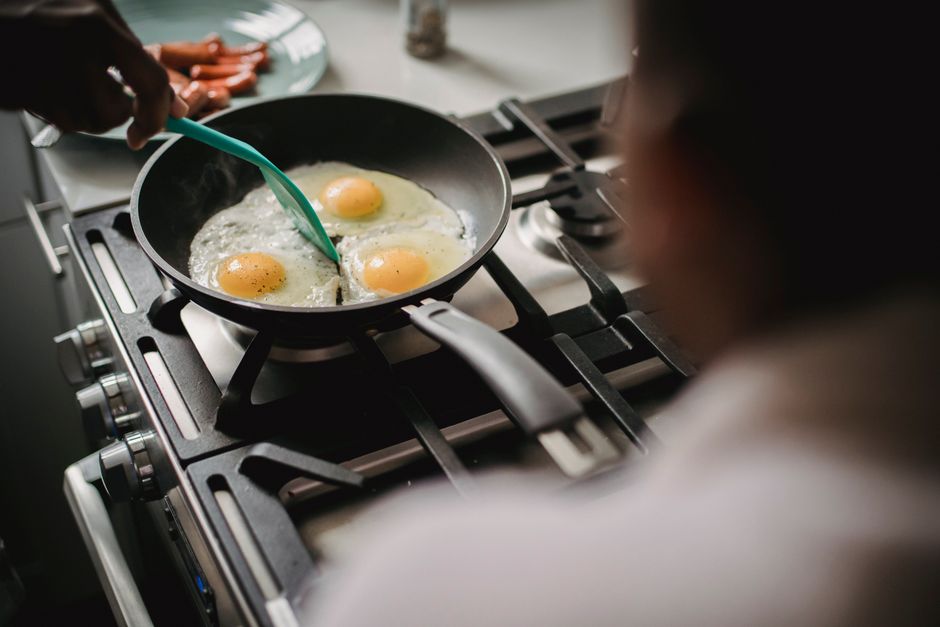
A higher number does not need expensive meat or powders. The cheapest foods on most shelves are also dense in protein [7]. How you cook them matters too. In a Belgian study using stable isotopes, people absorbed 90.9% of cooked egg protein but only 51.3% of raw egg protein [8].
- Build your weekly shop around 3 or more low-cost staples. Protein per 100 g: canned tuna about 25.5 g, canned sardines about 24.6 g, peanuts about 24.4 g, firm tofu about 17.3 g, eggs about 12.6 g, cottage cheese about 10 to 12 g, cooked lentils about 9 g, whole milk about 3.2 g [7].
- Buy dry beans and lentils in bulk, and canned fish when it is on offer. They keep for months.
- Always cook eggs until the white and yolk are firm, since raw egg protein is only about half absorbed [8]. If a recipe needs raw egg, use pasteurized eggs.
- Use dry soy chunks: soak them, then cook them in any sauce [7].
Within 2 weeks your shop includes 3 cheap protein staples, and your eggs are always cooked.
Step 5: Raise Your Number When Pregnant, Dieting, Ill or Older

WHY THIS MATTERS
Your Step 1 number is not fixed. Pregnancy and breastfeeding add to it: the European Food Safety Authority advises an extra 1, 9 and 28 g a day in the first, second and third trimesters, and an extra 19 g a day in the first 6 months of breastfeeding, then 13 g after that [6]. In most cases a regular diet that covers your energy needs covers this, with food rather than high-protein supplements [6]. A calorie cut raises the number too (Step 1) [3].
- Over 65, recalculate with 1.0 to 1.2, or 1.2 to 1.5 if you are ill and your doctor agrees: about 84 to 105 g at 70 kg [2].
- Pregnant: add 1 g a day in the first trimester, 9 g in the second and 28 g in the third. Breastfeeding: add 19 g a day, then 13 g after 6 months [6].
- Dieting: use the fat-loss range from Step 1 [1] [3].
- When appetite is low, set a reminder every 2 to 3 hours and eat a small, soft protein snack: scrambled eggs, yogurt, cottage cheese, soft fish, tofu or lentil soup.
- If you have kidney disease, ask your doctor for your own number before eating more. Older people with severe kidney disease who are not on dialysis may need to limit protein [2].
Within 4 weeks you reach your adjusted number on most days, and your weight stays steady or changes only as planned.
Step 6: Track It and Make It Stick
WHY THIS MATTERS
There is no good blood test for protein status, so the way to know your intake is to count it [6]. A week of counting shows whether you are near your number.
- For 7 days, write your grams of protein each evening, from labels or food tables [7].
- Work out your 7-day average and compare it with your Step 1 number.
- If you are more than 10 g short, add one item from your Step 4 list to the meal that is lowest.
- Re-count for 7 days on day 21, and again whenever your weight, age group, training or pregnancy changes your number [1] [2] [6].
By week 4 your average is within 10 g of your target on most days, and you can name your protein foods for each meal without counting.
When to Get Help
See a doctor or dietitian if you have kidney or liver disease, lose weight without trying, feel weaker week after week, or are pregnant and struggling to eat. Severe kidney disease may need a lower protein intake, so ask before eating more [2]. In an emergency, call your local emergency number.
Go further
- Pick Your Protein Foods: Meat, Fish, Eggs and Dairy compares the animal foods one by one.
- Keep Your Muscle While You Lose Fat: Protein and Strength Training covers the full fat-loss plan.
- Eat Enough After 65: Protein, Appetite and Weight covers appetite and weight in older age.
- Eat Plant-based Without Missing Protein, B12 or Iodine covers the other nutrients plant eaters need.
- Keep and Rebuild Muscle After 40 covers the training side.
- Food First, Then the Few Supplements That Work: Beetroot, Coffee, Creatine and Protein covers protein powders.


