
Basics: five habits you can start tonight.
It is 11:40 pm. You were yawning on the sofa an hour ago, but now the lights are off and your mind is wide awake. You go over tomorrow's meeting, check the clock, and do the maths on how many hours are left. Maybe you had a coffee at 4 pm to get through the afternoon. When researchers pooled 24 studies, caffeine cut total sleep by 45 minutes and took 11 minutes off deep sleep [1]. Small choices like that cup add up, and most of them sit inside five habits you can learn.
Step 1: Hold One Wake Time and Get Morning Daylight

WHY THIS MATTERS
Your wake time is the anchor of your body clock, and the GP guide asks for the same wake time every day, weekends included [3]. Light is the signal that sets the clock each morning. Light experts recommend at least 250 melanopic lux at the eye during the day [2], a level most rooms never reach [2].
- Pick one wake time you can keep 7 days a week [3]. Hold it within 30 minutes. Put the alarm across the room so you have to stand up to stop it.
- Open the curtains as soon as you get up, then go outside early in the day [8]. Aim for 10 to 30 minutes within an hour of waking: walk to the bus, drink your coffee on the step, or take the dog out. On cloudy or winter days stay out for the longer time. Outdoor light is still far brighter than indoor light [2].
- Go to bed when you feel sleepy, not at a fixed hour while you are still alert [3]. Your bedtime settles on its own once your wake time is steady.
Within 2 weeks your wake time varies by 30 minutes or less, and you start feeling sleepy at about the same time each evening.
Step 2: Wind Down With Dim Light, a 5-Minute List and a Warm Bath

WHY THIS MATTERS
Three things block sleep at bedtime: bright light, a busy mind and a warm core. Light experts set a limit of 10 melanopic lux at the eye from 3 hours before bed [2], far below ordinary room lighting [2]. For the mind, a sleep-lab trial with 57 adults found that people who wrote a specific to-do list for the coming days for 5 minutes fell asleep in about 16 minutes, against about 25 minutes for people who wrote about tasks already done [4]. The more specific the list, the faster they fell asleep [4]. For the body, a warm bath or shower draws blood to your hands and feet, which lets heat leave your core as you lie down [5].
- From about 3 hours before bed, keep the light low [2]. Turn off overhead lights, use one low lamp, and set screens to the lowest brightness.
- Start the same 30 to 60 minute routine at the same clock time each night, in the same order. For example: bath, pyjamas, teeth, then a paper book. Relaxing your mind and body is part of getting to sleep [8].
- Take a warm bath or shower of 40 to 42.5 C (104 to 108 F), 1 to 2 hours before lights out [5]. As little as 10 minutes is enough [5].
- Sit down for 5 minutes with a notebook and write a specific to-do list for tomorrow and the next few days [4]. Write "email Ana about the Friday report", not "work stuff" [4].
Within 2 to 3 weeks, the time it takes you to fall asleep drops toward 10 to 20 minutes on most nights.
Step 3: Set Up a Cool, Dark, Quiet Bedroom Used Only for Sleep
WHY THIS MATTERS
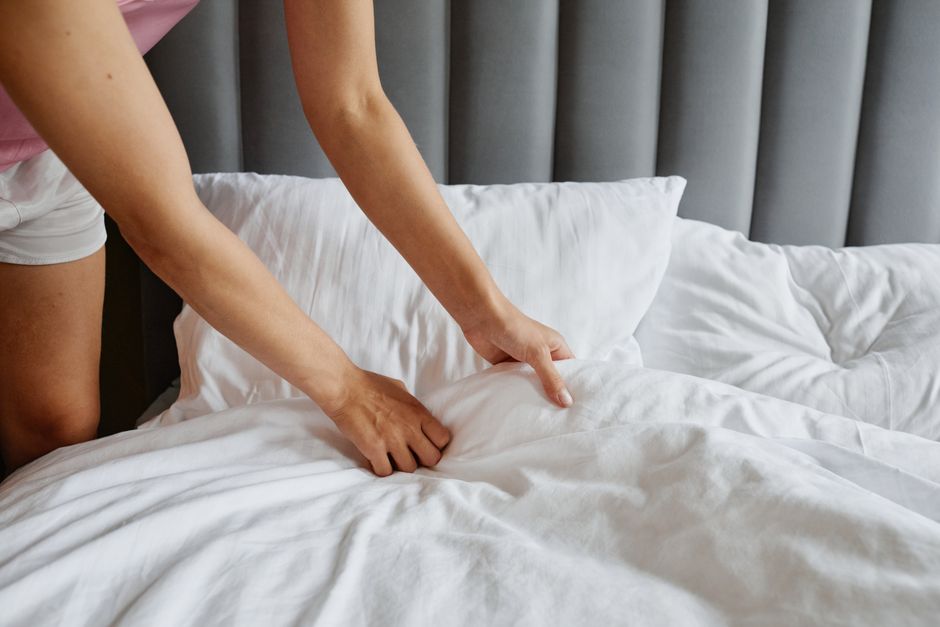
Heat, light and noise can wake your brain without you noticing; even a change in low background noise can wake you [6]. A bedroom of about 16 to 18 C (61 to 64 F) is ideal for most people [6]. The light limit for a bedroom is 1 melanopic lux [2], close to full darkness. And a bed used for TV, work or worry stops signalling sleep, which is why stimulus control keeps the bed for sleep only [3].
- Make it cool: about 16 to 18 C [6], with bedding that is neither too hot nor too cold [8].
- Make it dark: aim for a room where you cannot see your hand. Blackout blinds help reach the 1 melanopic lux limit [2]. Cover standby lights with tape.
- Make it quiet [8]. If you cannot control noise from roads, trains or neighbours, a steady white noise can help [6].
- Use the bed only for sleep and sex. No reading, TV, eating or worrying in bed [3]. Keep phones and tablets out of the bedroom [8].
Within 2 weeks you wake less often from heat, light or noise, and lying down in bed starts to feel like the cue for sleep.
Step 4: Time Your Caffeine and Alcohol Cutoffs
WHY THIS MATTERS
Caffeine keeps working long after the last sip. A 2023 meta-analysis worked out that a regular coffee (about 107 mg of caffeine) should be finished at least 8.8 hours before bed, and a standard pre-workout drink (about 217 mg) at least 13.2 hours before, to avoid losing sleep [1]. Alcohol feels like it helps, but in a review of 27 studies it reduced REM sleep from about 2 standard drinks, and more as the dose rose [7].
- Set your caffeine cutoff from your bedtime, not from how you feel [1]:
| Bedtime | Last regular coffee (8.8 hours) | Last pre-workout drink (13.2 hours) |
|---|---|---|
| 10 pm | 1 pm | 8:45 am |
| 11 pm | 2 pm | 9:45 am |
| Midnight | 3 pm | 10:45 am |
- Count every source: coffee, black, green and oolong tea, cola, energy drinks and some soft drinks [8], plus pre-workout powders [1].
- Keep alcohol out of the late afternoon and evening [3]. If you do drink, keep it under 2 standard drinks, where REM loss began [7]. Never use alcohol in place of a sleeping pill [8].
Within a week of keeping both cutoffs, you fall asleep more easily and wake up feeling clearer.
Step 5: Get Back to Sleep With the 20-Minute Rule

WHY THIS MATTERS
Trying to force sleep tends to backfire: the longer you lie in bed trying, the more your brain links bed with being awake [3]. Bootzin's stimulus control breaks that link by getting you out of bed when sleep will not come, and back in only when you are sleepy [3]. The NHS also advises keeping clocks out of view [9].
- Turn the clock face away and keep your phone out of reach [9], so you guess the time instead of checking it.
- If you feel you have been awake for about 15 to 20 minutes, get up and leave the bedroom [3]. Go somewhere quiet, dark and safe [8].
- Do something relaxing, such as reading something dull or listening to soothing music, and avoid eating or TV [3]. Keep the light low [2].
- Go back to bed only when you feel sleepy [3]. Repeat as often as you need to, and still get up at your anchor wake time [3].
Within 2 to 3 weeks, you spend less time lying awake, and you get back to sleep faster when you wake.
Track It
For 7 days, write down two things each morning: your wake time and roughly how many minutes it took you to fall asleep. Guess them in the morning; do not watch the clock at night [9]. On day 21, track them for another 7 days and compare. Aim for most nights within 15 to 20 minutes to fall asleep [3] and a wake time that stays within 30 minutes.
When to Get Help
See a doctor if your snoring is loud and frequent or someone notices you stop breathing in your sleep [8], if you feel strongly sleepy during the day [8], or if poor sleep keeps affecting your daily life even after these habits [8]. Ask about CBT-I, a drug-free treatment built on steps like these [3] [10].
Read next
- Find your sleep need, your chronotype wake time and the exact light dose: Fix Your Body Clock: A Steady Wake Time and Morning Light
- Cooling, bedding, blackout and noise fixes in detail: Make Your Bedroom Cool, Dark and Quiet
- Find your own caffeine cutoff and caffeine-free lifts: Time Your Caffeine So It Helps by Day and Not at Night
- Night-waking triggers and early waking: Get Back to Sleep After Waking at 3 am or Too Early
Get help: If worry or low mood is keeping you awake and you feel unsafe, call your local emergency number or find a free helpline at findahelpline.com.