

How to score all 8 parts of your life, give one season to the weakest, keep 5 weekly foundations safe, and reset every 3 months.
Here's What's Actually Going On
It is November. A friend asks you to help run a community event in March. March feels far away and roomy, so you say yes on the spot. In March, that event lands in the same weeks as a work deadline, a family birthday and the evenings you meant to spend sleeping, training or simply resting.
This happens to nearly everyone. In 7 experiments, people expected more spare time in the future than they had now, and this hope was stronger for time than for money [1]. Your week does not grow. Every yes to one part of life is a quiet no to another, whether you notice it or not.
Step 1: Score Your 8 Pillars From 0 to 10

WHY THIS MATTERS
You cannot balance what you cannot see. Most people judge their life by whatever hurts loudest this week, which hides slow problems such as a shrinking friendship circle or a savings account that never grows. Well-being depends on social, economic and environmental conditions as well as health, and it includes meaning and purpose [2], so a fair picture needs all 8 parts on one page.
- Take one sheet of paper or one phone note. Write the 8 pillars in a column: Physical (body, sleep, movement, food), Emotional (mood, stress, how you cope), Intellectual (learning, curiosity, focus), Social (friends, family, community), Spiritual (meaning, values, faith or reflection, whatever fits your beliefs), Work (your job, studies or main daily role), Money (income, spending, debt, savings) and Home (your living space and surroundings).
- Score each one from 0 to 10 for the last 4 weeks, not for your best or worst day. Use these anchors: 0 to 2 means it is in crisis or causing harm; 3 to 4 means it often drags you down; 5 to 6 means it is okay but shaky; 7 to 8 means it is steady and mostly good; 9 to 10 means it is a real strength you rarely worry about.
- Circle your lowest score and your highest score, and write the gap between them. This gap is your spread.
- Date the sheet and keep it where you will find it in 3 months. You will score again at your quarterly reset (Step 6), and comparing sheets is how you see progress [6].
- Circle your limiting pillar: the low pillar that, if it rose 2 points, would lift 2 or more others. If a pillar scores 0 to 2 for reasons you cannot change alone, it comes first and needs outside help.
In 15 to 20 minutes you have 8 dated scores, 8 lines of evidence, and one number for your spread.
Step 2: Give One Season to That Pillar, With 1 to 3 Goals
WHY THIS MATTERS
When everything is a priority, every request seems to fit somewhere. In a series of studies, detailed plans helped people reach a single goal, but making plans for many goals at once made those goals feel harder and weakened commitment to them [3]. A season with one focus and only 1 to 3 goals keeps your plan small enough to stick, and it gives you a simple test for every new request: does this help my season pillar, or pull from it?
- Set the season at about 12 weeks, with a start date and an end date in your calendar. Twelve weeks also matches the quarterly reset in Step 6.
- Write 1 to 3 goals, all for your limiting pillar. Make each one something you can count: "Asleep by 11 pm on 5 nights a week", "Have dinner with a friend twice a month", "Save a small fixed amount every payday".
By the end of week 1 you have one season pillar, 1 to 3 written goals with numbers, an end date, and a later list.
Step 3: Turn Your Top Goal Into One Small Habit After a Daily Anchor
WHY THIS MATTERS
Goals tell you where you want to go; habits get you there on days when you do not feel like it. In one trial with 192 adults over 84 days, people who tied a new healthy habit to a fixed cue in their daily routine reached their highest automaticity at a median of 59 days, about 2 months, and repetition was the key ingredient [4].
- Shrink your top goal into one action of 2 to 10 minutes. "Get fit" becomes "a 10-minute walk". "Sleep more" becomes "phone on the charger in the kitchen".
- Write the rule as one sentence: "After I [anchor], I will [small action]." Example: "After I lock the front door at night, I put my phone on the kitchen charger."
- Plan for about 2 months before it feels automatic, and do not add a second habit before then [4]. For some people it takes much longer, so a habit that still feels like effort at week 6 is normal, not failure [7].
By week 4 you tick your habit on most days, and by about week 8 it starts to happen without much thought.
Step 4: Protect Your 5 Weekly Foundations

WHY THIS MATTERS
Foundations are small weekly basics that hold up several pillars at once, so losing one hurts more than it seems. They keep the 7 pillars you are not focusing on from sliding while you give the season to one. Each of the 5 has evidence behind it. Sleep and movement guidelines for adults set 7 to 9 hours of sleep and at least 150 minutes of activity a week [5].
- Write your 5 foundations on one card or phone note, with your own numbers:
- Sleep: 7 to 9 hours of good sleep for adults aged 18 to 64, with consistent bed and wake-up times [5], or 7 to 8 hours from age 65 [8].
- Movement: at least 150 minutes a week of moderate to vigorous activity, such as 30 minutes of brisk walking on 5 days, plus muscle strengthening twice a week [5].
- One honest talk: one conversation a week about something real, such as how you are or a worry, not just logistics [9].
- An untouched money buffer: an automatic transfer on payday, even a small one, into an account you do not use for everyday spending, so that cash you can reach grows [10].
- One meaningful or kind act: a shared meal [11], a visit, help for someone, or quiet time for prayer, meditation or reflection, whatever fits your beliefs.
- Every Sunday, count how many of the 5 you kept that week and write the number next to your habit ticks.
Within 3 weeks you keep at least 4 of your 5 foundations most weeks, and you know which one slips first.
Step 5: Ask "What Will This Push Out?" Before Any New Yes
WHY THIS MATTERS
A request always feels smaller when it sits in the future, because people expect to have more spare time later than they have now [1].
One question before every yes makes the hidden cost visible: "What will this push out?"
- Ask the question out loud: "What will this push out?" Name the exact hours that lose: "2 Thursday evenings with my kids and one weekend run."
- Check those hours against your card: does the yes take time from your season habit or break one of your 5 foundations? If yes, either reshape the request (fewer hours, later start, online) or decline it. For words to use when you decline, see the Go further list.
Within 2 weeks you stop agreeing on the spot, and each yes you give comes with a written hour cost and a named trade.
Step 6: Run a Quarterly Reset From Your Calendar
WHY THIS MATTERS
Pillars drift as life changes, even when nothing seems wrong. A short reset every 3 months catches problems while they are small.
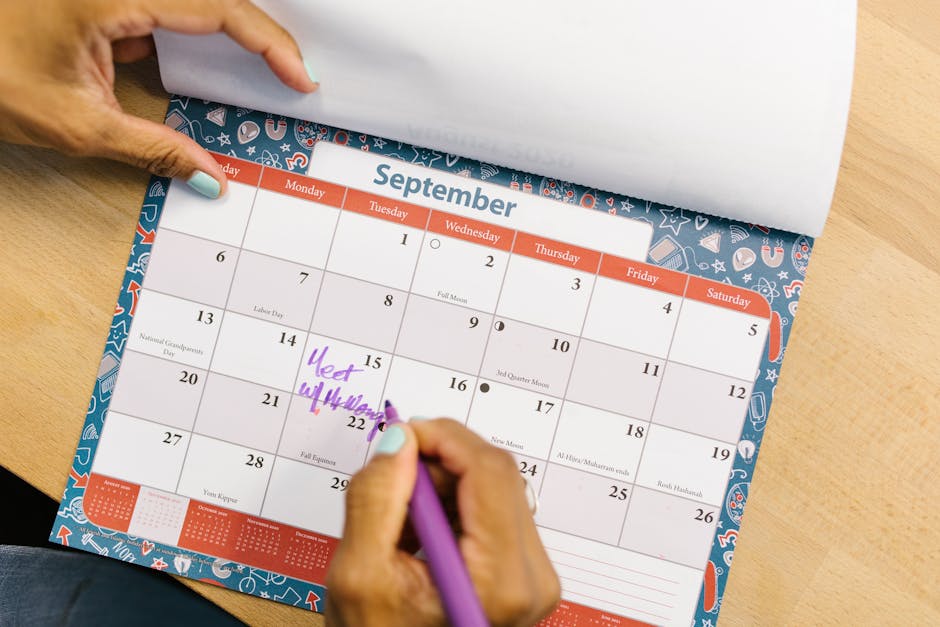
- Put 4 resets in your calendar now, about 12 weeks apart, each lasting 45 to 60 minutes. Set a reminder 1 day before.
- At each reset, score your 8 pillars again from 0 to 10 with new evidence lines (Step 1). Put the new sheet next to the old one and write the change for each pillar.
- For each habit, decide one of 4 things: keep it (it runs on its own and still helps), change it (it helps but needs to be smaller or moved to a better anchor), grow it (it is automatic and can do more), or retire it (it no longer fits) [12].
After your first reset you have 2 score sheets to compare, every habit marked keep, change, grow or retire, and a written plan for the next season.
Track It
For the next 7 days, tick your season habit each day and count your foundations kept on Sunday. Score your 8 pillars again at your first reset in 12 weeks and compare the 2 sheets.
Go further
- Hold a Renewal Day and a Yearly Review covers the longer yearly review that sits above the quarterly reset.
- A Kind No Protects a Real Yes has the scripts for saying no kindly.
- Purpose Is a Practice, Not a Discovery goes deeper into the meaningful-act foundation.


