

Doctor's Note: See a doctor or therapist if surges come most days, last for hours, or keep hurting your relationships, work or school, and ask about dialectical behaviour therapy (DBT), whose skills training cut self-harm in a trial with people at high risk [1]. If a surge brings urges to hurt yourself or someone else, contact a crisis line now: call or text 988 in Canada and the US, or find your country's line at findahelpline.com [2]. If anyone is in danger, call your local emergency number.
Your heart is pounding. Your jaw is tight, your face is hot, and the angry message is already typed. Your thumb is over Send. A minute ago you could think. Now every thought pushes you further.
That is a surge, and it is normal to lose your tools at the top of one. In a German study of 24 people trained in emotion skills, all 24 said their skills worked differently depending on how tense they were, and 16 struggled to use skills at all when tension was very high [3]. This article gives you tools for each level, starting with the body, because the body is what still listens at the top.
Step 1: Know Your Number and Your Switch Point
WHY THIS MATTERS
In the German study, 20 of 24 people said that noticing their own level of tension was the first thing they needed before any skill could work [3].
- Write a short 0 to 10 scale in your phone notes, in your own words. For example: 3 = short temper, 5 = hot face, 7 = shaking hands, 10 = out of control.
- Set your switch points. 3 to 5: breathe (Step 2) or ground yourself (Step 5) now. 7 or more: no thinking tools, go straight to cold (Step 3) or stairs (Step 4).
- For 2 weeks, set 3 phone reminders a day and rate yourself in 2 seconds each time [3].
Within 2 weeks you rate yourself in 2 seconds and start using tools at 5 or lower.
Step 2: Calm Your Body in Two Minutes With Your Breath
WHY THIS MATTERS
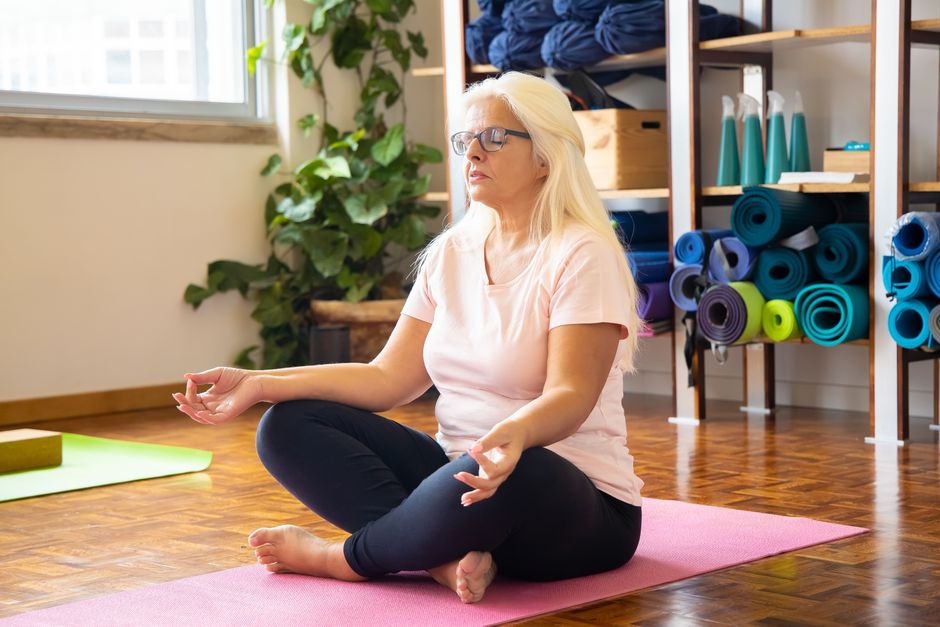
A sigh works as a reset for your breathing and brings relief [8]. In a Belgian study of 30 adults, a short in-breath and a long out-breath made people feel more relaxed and less stressed than the reverse, at the same speed [4].
- Do 1 to 3 physiological sighs: breathe in through your nose, take a second short sniff on top, then breathe out slowly through your mouth until your lungs feel empty.
- Then breathe in for 3 counts and out for 7 counts, about 6 breaths a minute, for 2 minutes [4].
- In public, breathe out slowly through your nose. Nobody can see it.
- Re-rate yourself. Under 5, go to Step 5. Still 7 or more, go to Step 3 or 4.
A 5 or 6 drops by 1 to 3 points within 2 minutes.
Step 3: Above 7, Put Your Face in Cold Water

WHY THIS MATTERS
Cold water on the face while you hold your breath sets off the diving response, which slows the heart. Across 17 studies with 311 people, it raised the heart's calming activity clearly while the cold lasted, but not after [5]. So follow it with slow breathing.
- Fill a bowl or sink with the coldest water you have. One study used 10 C water [9].
- Hold your breath, lean forward and put your face in from forehead to chin for up to 30 seconds [9].
- No sink? Hold a cold pack or frozen peas over your eyes and cheeks for 30 seconds while holding your breath.
- Then do 2 minutes of long out-breaths from Step 2 [5].
Safety: In 54 healthy teenagers, 8 had extra heartbeats during face immersion, and the risk may rise with breath holding [9]. Skip this and ask your doctor first if you have any heart condition, a slow pulse, take heart medicine or faint easily.
An 8 comes down within a minute or two, far enough for breathing and grounding to work.
Step 4: Or Burn Off the Surge With Fast Stairs

WHY THIS MATTERS
In a study of 60 people afraid of their own body sensations, 2 weeks of exercise cut that fear far more than waiting did [6]. Moving hard uses up the fight-or-run energy and teaches you that a racing heart is not danger.
- Move hard for 5 to 10 minutes: stairs, star jumps, a sprint or a fast uphill walk. You can say a few words but not hold a conversation.
- As you move, tell yourself: "This is my body working. It is not danger" [6].
- Stop, stand for 1 minute, do 3 long out-breaths and re-rate.
Safety: With high or unknown blood pressure, chest pain, a heart problem, an injury or pregnancy, ask your doctor first and walk briskly instead.
The energy is spent within 10 minutes, and a racing heart starts to feel less frightening.
Step 5: Ground Yourself and Wait Until You Are Under 5
WHY THIS MATTERS
A review of 306 experiments found that moving attention away from the trigger lowered emotion, while concentrating on the feeling made it worse [7].
- Name 5 things you can see, 4 you can touch, 3 you can hear, 2 you can smell and 1 you can taste, with your feet pressed into the floor.
- Keep one rule: no message, purchase, decision, drink or drive while you are above 5.
- Write the message as a draft, put the phone in another room and set a 20-minute timer. If someone is in front of you, say: "I need 20 minutes. I'll come back to this."
Within about 5 minutes you are under 5, and most urges wait until you can choose.
Step 6: Keep a Small Kit and Check HALT
WHY THIS MATTERS
People in the German study said they had to carry their skills to use them in an emergency, and that what worked was personal [3]. Hunger goes with more anger and irritability in everyday life [10].
- Pack 3 items you have tested: a cold pack, a strong mint, and a card with your scale and your under-5 rule.
- Once you are under 5, check HALT: are you Hungry, Angry, Lonely or Tired? Eat, move, text one person or rest before you go back to the problem [10].
You use your kit in most surges and notice fewer surges on days you have eaten and slept.
When to Get More Help
If surges come most days, last for hours, or keep hurting your relationships, work or school, talk to a doctor or therapist and ask about dialectical behaviour therapy (DBT). In a trial with 99 women at high risk of suicide, DBT that included skills training cut self-harm more than DBT without it [1]. If a surge brings urges to hurt yourself or someone else, contact a crisis line now: call or text 988 in Canada and the US, or find your line at findahelpline.com [2]. If anyone is in danger, call your local emergency number.
Track It
Each evening for 3 weeks, write your highest number of the day and whether you used a tool before you acted. Your goal: fewer days above 7, and a tool used first in most surges.
What to Do Next
- Today: write your 0 to 10 scale and your under-5 rule on your phone.
- This week: practise 2 minutes of long out-breaths every day and try the cold face reset once while calm (if it is safe for you).
- This month: pack your kit and keep your surge log for 3 weeks.
Myths
Myth 1: "If I just think it through, I'll calm down."
At high tension, most people in the DBT study struggled to use any skill, and some said they forgot them entirely [3]. Thinking works better once the body has come down. Rethinking worked well in the research [7], but it comes after the cold, the stairs or the breath, not instead of them.
Myth 2: "Venting the feeling, going over it in detail, gets it out."
In a review of 306 experiments, concentrating on the feeling made it stronger, while moving attention away lowered it [7].
Myth 3: "Breathing slower is what calms you."
Slow breathing helps, but the bigger effect on feeling relaxed came from a long out-breath compared with a long in-breath [4].
Myth 4: "Cold water on the face is safe for everyone."
Even in healthy teenagers, 8 of 54 had extra heartbeats during face immersion in 10 C water, and breath holding may raise the risk [9]. Ask a doctor first if you have any heart condition.
Myth 5: "Being hangry is just an excuse."
In over 9,000 everyday check-ins, higher hunger went with more anger and irritability [10]. Eating does not excuse what you do, but it is part of calming down.
FAQ
How fast should these tools work?
The cold face reset works while the cold lasts [5], so expect the peak to break within a minute. Long out-breaths take about 2 minutes, and fast stairs 5 to 10 minutes. If you are still above 7 after two tools, use your help plan.
Which tool should I use first?
Use your number. At 3 to 5, use the breath (Step 2) or grounding (Step 5). At 7 or more, use cold or stairs first, because thinking tools do not reach you there [3].
Does exercise help even if I'm not fit?
Yes. Smits's programme worked over 2 weeks for people chosen for their fear of body sensations, not for fitness [6]. A brisk uphill walk counts.
Is having big surges a sign of a mental illness?
Not by itself, and this article cannot diagnose anything. If surges come most days, last hours or hurt your life, a doctor or therapist can help you find out what is going on and whether DBT fits [1].
Where can I get help right now?
Call or text 988 in Canada and the US, or find your country's line at findahelpline.com [2]. Call your local emergency number if anyone is in danger.
Skill Check
| Step | Starting | Solid | Strong |
|---|---|---|---|
| 1. Your number | You notice surges at 8 or more | You notice most surges at 5 or 6 | You catch most surges at 3 to 5 |
| 2. Sigh and long out-breath | You know the pattern | You use it in most surges at 5 | It starts on its own in public, unseen |
| 3. Cold face reset | You know if it is safe for you | You have a cold pack ready | You use it above 7 and follow it with breathing |
| 4. Fast stairs | You know your nearest stairs | You practise once a week | A racing heart no longer scares you |
| 5. Ground and wait | You know 5-4-3-2-1 | You delay most messages until under 5 | You rethink only once you are under 5 |
| 6. Kit and HALT | You have picked your items | Your kit is where surges happen | You run HALT before going back every time |
| 7. Log and help plan | You saved the crisis number | You logged 2 weeks | You review weekly and know when to get help |
Go further
- Spot a Surge Early and Map Your Triggers: Your Warning Signs and 0-to-10 Scale maps what sets your surges off.
- Get Through an Emotional Crisis Without Making It Worse: STOP, ACCEPTS and Pros and Cons covers the other DBT crisis skills.
- Ride Out a Self-harm Urge: Delay, Cold, Movement and Urge Surfing is for urges to hurt yourself.


